Friday, February 2, 2018

Math in Action 2018: Project Based Learning

Bringing Project Based Learning (PBL) into your Mathematics Classroom


Connor Bilkos, Kim Bringelson, and Madelyn Johnson, and Jon Hasenbank
Grand Valley State University
Session C4, 11:00 A.M. - 12:00 P.M.

Presented at the 2018 Math in Action Conference at GVSU.
Learn how you can use PBL to create a meaningful, engaging mathematical experience. Be inspired and leave with resources you can use right away! Includes examples from geometry and more.

Google Slides Presentation:


Thursday, December 14, 2017

Reflections on Conferring

Conferring is purposeful helping aimed at developing students' capacity for learning. Conferring is more than merely providing information. I think of it like this: 

Give a person a fish and you feed them for a day (helping)
Teach them to fish and you feed them for a lifetime (conferring)

I taught a lesson about conferring recently with my pre-service mathematics teachers. Here's what we did, how it went, what I'll change for next time, and what we learned.

Wednesday, December 13, 2017

QTP: Rich tasks are for everyone


Overheard: The modified "rich version" of the task would have been too difficult for some students, so we gave them the original worksheet and one teacher took those students aside to work on it together. 

But... If the rich version of the task is "better" for learning, why shouldn't the struggling students work on it too?

QTP = Quick Thought Post

Friday, June 23, 2017

Advice for Getting Started with SBG

One of our teacher ed grads emailed one of my colleagues in search of SBG resources for a pre-algebra course he's developing for next year. He wrote:
When I had you for ____, you graded our assessments using a form of standards based grading. I remember receiving a paper back that listed what standards I had mastered and which ones I still needed to work on. I have wanted to try using a standards based grading system ever since I saw it in your classroom. Would you have any resources that you would be willing to share with me?
My colleague replied with several tips and resources, including Matt Townsley's growing list of scholarly articles SBG. He also Cc'd me, and while I was drafting my own response I realized it might be better to write it as a blog post. So here it is, for what it's worth: my list of suggestions and resources for getting started with SBG in the math classroom.

Monday, February 6, 2017

MIA2017 - Do you have a growth mindset?

We share how the math teachers in our hall
empowered kids by focusing on growth mindset.
(Based in part on Boaler's book Mathematical Mindsets)

Our presentation was part of GVSU's
2017 Math in Action Conference
Saturday, Feb. 25, 2017


Session Resources:

Handouts:


Saturday, February 27, 2016

MIA2016 - Coaching Principles in the Mathematics Classroom

Molly Carter, Jamie Stuart, and I presented the following session at the 2016 Math in Action conference. Our talk was called "Promoting Collaboration During Problem Solving: Coaching Principles in Action". Here are our slides and electronic versions of the session handouts. Thank you for attending! 

Wednesday, February 24, 2016

Best Teaching Practices, by GVSU's Math Student Teachers

Over the years, our math student teachers have shared their best ideas and most memorable experiences from the mathematics classroom. We prompt them by asking what they have seen or done that will stick with them or have a lasting impact on their practice. I thought I would share it here in the hope that others may find something useful.

Feel free to submit your own ideas or experiences in the Comments.

Wednesday, October 28, 2015

TMWYK What if you


Here's an exchange I had with my almost-7-year-old where I use "What If" to stretch his thinking a bit further:

Me: Hey, why did you choose 7-2=5 for this stretch your thinking question? Is it because you just did that one on #5?

Thursday, September 10, 2015

Transformations vs. Order of Operations


The following question was raised by one of the work groups in class today: Why is the order of performing transformations different than the order of operations?

We are studying function transformations like these:
From College Algebra by Coburn & Herdlick


Our explorations in class have supported our book's claim that function transformations must be applied in the following order:
  1. horizontal shifts
  2. reflections
  3. stretches/compressions
  4. vertical shifts
Does that sequence conflict with the order of operations? What a great question! Let’s explore it using the absolute value function f(x) = |x| as our parent function and using
g(x) = -2|x-1| + 5.
to define the intended transformation. Consider what happens to a point on the graph of y = |x| under this transformation. Let's use the point (5,5). Where does it end up after the transformation?

To find out, we evaluate f(5)= -2|5-1| + 8. This requires the following sequence of calculations:

  1.     5-1 = 4.         that’s the x-1 piece; there’s the horizontal shift*
  2.     |4| = 4.           that’s |x-1|; we have just applied the parent function, |x|.
  3.     -2*4 = 8.       that’s -2|x-1|; there’s the reflection (-) and vertical stretch (by 2).
  4.     8+5 = 13.      that’s -2|x-1|+5; there’s the vertical shift.
*But why is it a rightward shift? That's for another post.
Has the order of operations been maintained?

It is probably easiest to see if we use GEMA rather than PEMDAS to track the order of operations. They reflect the same underlying order of operations, but GEMA seems to produce fewer order of operations misconceptions (sounds like a PhD thesis topic to me!)

GEMA = Grouping symbols first, then Exponents, then Multiplication (and Division, from left to right), and finally Addition (and Subtraction, from left to right).

Now let’s step through GEMA:
G: Grouping symbols. The absolute value bars a type of grouping symbol (so are parentheses and brackets, square root symbols, and even the horizontal line that separates the numerator and denominator in a fraction). First, we work on the expression inside the grouping symbols (absolute value bars). There is only one operation to do in there: subtract 1 (step 1). Now we apply the absolute value bars (step 2), at which point the Grouping symbols are gone and we move on to….

E: Exponents. No exponents to deal with this time. Move on to….

M: Multiply (or Divide): With the || bars gone, the function now reads: f(4) = -2*4 + 5. We multiply by -2 next. This creates the reflection (step 3a) and stretch (3b).

A: Add (or Subtract): Only one thing left to do! (step 4).
Conclusion: It appears the transformations sequence is consistent with the order of operations.

I'm convinced. Are you?

Monday, February 23, 2015

Giving Effective Feedback

I had a nice discussion with my assessment committee colleagues today. Afterwards, at the request of one of my colleagues, I shared a few resources about effective feedback. I decided to kill two birds worth one in a handbasket by posting them on my blog, too.
Source: eatoneducationalinsights.edublogs.org

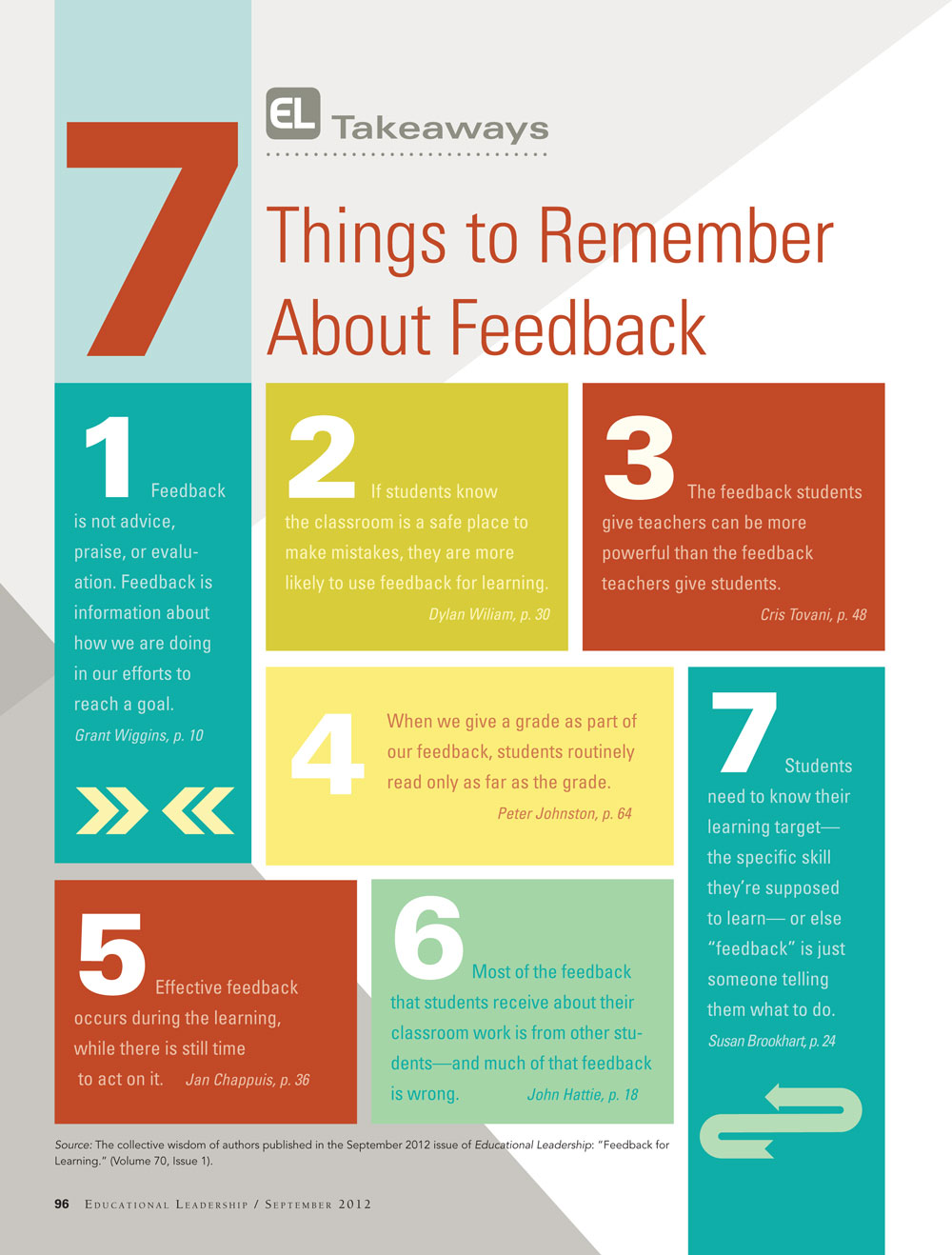
The first resource that came to mind is this article by Grant Wiggins (2012): Seven keys to Effective Feedback.

I also like this article (from the same September 2012 issue of Ed Leadership) by Fisher & Frey (2012): Making Time for Feedback. It offers practical feedback strategies, including this gem: it can be counterproductive to mark every mistake a student makes.

Actually, the collection of abstracts suggests the entire Sept 2012 issue may be a treasure trove of excellent articles on feedback. I'll have to check out the rest when I have more time.

Finally, I encourage anyone looking for a more in depth look at feedback to check out the first chapter of Classroom Instruction that Works (2nd ed.):


Inspiration Post

For all those who need this today.

https://s-media-cache-ak0.pinimg.com/736x/2b/de/d3/2bded3e02dfc2f5d55ab162b296baf43.jpg

Wednesday, February 18, 2015

MIA2015 - Facilitating Growth through SBG

How can the use of standards based grading support a growth mindset in students?

Presented at GVSU's Math In Action Conference 
Saturday, Feb. 21, 2015 
by Dr. Pamela Wells and Dr. Jon Hasenbank
(Session E6, 1:20-2:20 pm)
See below for slides and resources.

Saturday, February 14, 2015

AMTE 2015: Using Standards Based Grading with PSTs

This page hosts the materials for the presentation by Jon Hasenbank and Pamela Wells on the use of standards based grading in math courses for future teachers (presented at AMTE 2015).


Friday, February 13, 2015

AMTE 2015: Supporting Growth Through Cognitive Coaching

This page hosts the materials for the presentation by Profs Coffey, Gerson, and Hasenbank on the use of Cognitive Coaching(SM) for preservice teacher field supervision (presented at AMTE 2015).

Coaching Information and Resources:


 AMTE 2015 Slides:


Tuesday, February 10, 2015

Finding the "Hidden Wows"

I was working with some middle school teachers-to-be who are noticing some of the aspects of algebra we tend to take for granted after years of practice and application, and they are noticing how difficult it can be to anticipate the strategies and struggles of students who are just learning algebra.
 
One way I get around that is to try to hold myself still with a problem for a bit and look for the hidden connections. With kids, I might tell them we're looking for the Hidden Wows.

Suppose I am preparing a lesson for sixth graders to introduce problems of this form:
Solve: ax = b
 My planning might start out sounding a bit like this:

Tuesday, February 3, 2015

SBG Indicators - Your Experience May Vary

Uh-huh...
Learning targets are hard to write.

Here's one (of 27) that I used in F'13:
D.3 I can calculate, work flexibly with, and demonstrate understanding of statistical measures of center and spread for numerical data, including: mean, median, MAD, and IQR.
If you tease that target apart, you realize it contains 12 distinct skills: {calculate, work flexibly with, and understand} x {mean, median, MAD, and IQR}.

That's a problem: such a complex target is very difficult to assess. Do they have to show all parts on a single task for a proficient score? Can they piece it together over several tasks? If so, how do we keep track?

So I swore off using complex targets for my Su'13 College Algebra course:

Tuesday, December 2, 2014

PSTs: "What I will do to make sure my elem students have a good math experience?"

I try to give my students plenty of opportunity to reflect on their growth as we approach the end of the semester. With that goal in mind, I had my students tell me what they remembered about their experiences with mathematics while they were in elementary school. You can read their responses by clicking the image.

Fast forward to the end of the semester. In our last week, I printed out those responses, cut them into slips of paper, and gave one slip to each student at random. They read their quote and talked about it at their table. Then they got up and found a partner ("find someone who has similar shoes") and read each other their quotes while discussing how they wanted their future students to say about their elementary math experiences.

Monday, December 1, 2014

Spurious correlations, three ways

I stumbled across a collection of spurious correlations a while back.

Here is one of them that struck me, in part because the data set links sour cream consumption per capita and motorcycle riders killed in non-collision transport accidents, but also because it is presented in odd sort of way.

Headline: Sour cream consumption linked to greater risk of non-collision transport death by motorcycle.

Saturday, November 29, 2014

TT-TNG (F14 edition)


Teaching Tips (from) The Next Generation
Presenting the inaugural edition of... Teaching Tips (from) the Next Generation: a summary of semester-end blog posts written by graduating secondary math teachers at Grand Valley State University.

They share their greatest areas of personal growth and their most powerful teaching strategies from their recently completed student teaching experiences.
(I will continue to add more as they come in. Last update: 12/1/14 at 12:55pm)