This is a PDF printout of my tweets to the #ed331 hashtag for Winter 2014. You may also view the saved search Twitter's website.
Wednesday, May 21, 2014

Sunday, May 4, 2014
When will I use this? (Laws of exponents?)
The Question:
I received the following email from my Mom the other day. (She's been a middle school teacher since the early '90s). She wrote:
Jon, I received The Question today from one of my 7th graders today: "When am I ever going to need to know how to do this???" He is working on zero and negative exponents and had to solve problems like this:
Write an equivalent expression for
.PNG)
The answer was
He understands how to do the problems--just wants to know why he needs to know, why it's not a waste of his time.

My Response:
Good questions! I wrote a blog post about the matter... let me know what you tell him. I'd love to hear how he responds.
http://profjonh.blogspot.com/
That Blog Post (AKA, This Blog Post):
My colleague answers that question this way:
(Read his full blog post at: http://deltascape.blogspot.com/2012/05/when-will-we-ever-use-this.html)I don't know when or if you will ever need this particular concept. It depends on what you do with your life and what technological advances are made in the future. But you know what you will need to be able to do, regardless? You will need to problem solve. You will need to think critically (reason and prove). You will need to be able to communicate quantitative thinking to others. You will need to use representations to support your thinking and share your thinking. And you will need to make connections in order to consolidate your understanding. Mathematics is a discipline that provides opportunities to practice and strengthen all of these skills. So, as we solve for x, I want you to monitor your thinking because that's what's really important.
He's talking about the Process Standards from NCTM (2000), which are now reflected in CCSS Standards for Mathematical Practice:
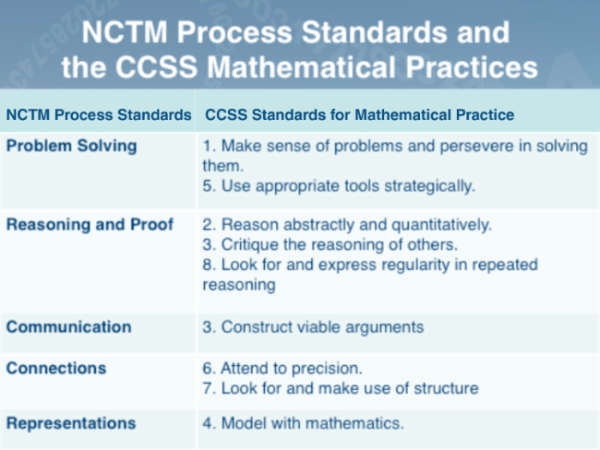
But just in case that argument doesn't satisfy your young math skeptic, you might want to share the following list of websites with him (see below). It turns out rational exponents are at the heart of a great many useful scientific formulas, not to mention a lot of really cool (and really beautiful) mathematics!
Good luck!
- Jon
Seven applications of rational exponents:
- Chemistry:
http://chemwiki.ucdavis.edu/Physical_Chemistry/Kinetics/Rate_Laws/The_Rate_Law - Modern Physics (Albert Einstein):
http://en.wikipedia.org/wiki/Mass%E2%80%93energy_equivalence#Mass-velocity_relationship - Classical Physics (Isaac Newton, born on Christmas Day, 1642!):
http://www.logrog.net/users/lkovach/physics/Universal%20Gravitation/Days%201-3.pdf - Rocket Science:
http://exploration.grc.nasa.gov/education/rocket/isentrop.html - Astronomy:
http://scioly.org/wiki/images/c/c6/Formula_Sheet.pdf - Wall Street investment trading:
http://fr.accuracy.com/visuels/28t-1271338388.jpg - Renewable Energy (Wind):
http://www.raeng.org.uk/education/diploma/maths/pdf/exemplars_advanced/23_wind_turbine.pdf
Sunday, April 27, 2014
Installing Cabinet Hardware (or, Fun with Fractions)
So I was installing cabinet hardware today...

...and some math happened! See, I had measured one drawer to be 17+3/8 inches wide. To place the pull correctly, I needed to find the center line of the drawer. So I needed to divide 17 3/8 by 2... not exactly compatible numbers.
Let's look at a few of my options.
Option 1: Use a calculator.
My laptop is sitting right here. It has a built-in calculator:
.PNG)
...and some math happened! See, I had measured one drawer to be 17+3/8 inches wide. To place the pull correctly, I needed to find the center line of the drawer. So I needed to divide 17 3/8 by 2... not exactly compatible numbers.
Let's look at a few of my options.
Option 1: Use a calculator.
My laptop is sitting right here. It has a built-in calculator:
Monday, April 14, 2014
Guest Post: The Value of Social Media for Teachers
The following is a reflection written by one of my preservice elementary mathematics teachers (@hollikathryn14) in W14, wherein she summarizes what she learned from an hour of professional development time spent with #MSMathChat on Twitter.
For some background on the assignment, see my post: Professional Growth for (New) (Math) Teachers.
 When I read her reflection, I was inspired. I thought she nicely captured the power of looking to social media for professional development, and I hoped that her experience and perspective (pre-service teacher, and Twitter newbie), might inspire others to give it a try.
 She graciously granted her permission for me to share this with you. And so, here's Holli's reflection on her first #MSMathChat experience:
Sunday, April 13, 2014
Professional Growth for (New) (Math) Teachers
(Note: I wrote this post for my preservice teachers looking to complete their required professional development experience for my course(s), but then I thought: why not make it general enough to share with the world? I have also tagged it under the cognitive coaching label because it parallels the structure of a coaching conversation: reflect on your goals, set a focus for growth, articulate an action plan, implement it, and reflect on what you have learned.)
 Looking for meaningful professional development? Have you tried Twitter? If not, I hope this post might help you (a) decide where you want to go and (b) learn about some social media options for getting what you need.
First, if you haven't already, I suggest you spend a few minutes brainstorming what you want to learn more about:
Look back over your list: What stands out to you? What are your priorities? What do you most want to learn more about? Set some goals for your professional growth.
First, if you haven't already, I suggest you spend a few minutes brainstorming what you want to learn more about:
- What are some of your strengths?
- What are some areas where you want to learn more?
 |
| It can be hard to hold yourself still... try setting a timer. |
Look back over your list: What stands out to you? What are your priorities? What do you most want to learn more about? Set some goals for your professional growth.
Reflecting on Your Professional Learning
(Note: This post was created as a continuation of the post "Professional Growth for (New) (Math) Teachers", but it is general enough to apply to any recently professional learning experience.)
 How do you reflect after a professional learning experience?
You might begin by responding to a few good questions, like:
Here are two nice options for framing a written reflection:
Option 1: What, So What, Now What?
Now... what's next for you?
How do you reflect after a professional learning experience?You might begin by responding to a few good questions, like:
- How has your thinking changed?
- What is important for you to remember from the experience?
- How does what you learned align with your personal goals?
- Who else needs to learn this?
If you don't have a blog, maybe it's time to start one? If so, help is available.
Here are two nice options for framing a written reflection:
Option 1: What, So What, Now What?
- What have you learned?
- So what? How will that impact your practice?
- Now what? What do you want to learn next?
- How did it go?
- How do you know?
- Why is that so?
- How did you grow?
- How did this help you know?
Now... what's next for you?
Wednesday, April 9, 2014
Is there a problem here?
Is there a problem here?
A student in my W14 teacher-assisting seminar raised this question:
 |
| from Doug Fisher's Michigan Reading Association Presentation (via delta_dc) |
A student in my W14 teacher-assisting seminar raised this question:
If the [desirable] Japanese lesson style* is all about posing meaningful problems and allowing students to explore them, and if the proper role of the teacher is to lend perspective and support in those investigations, then why are we taught to use gradual release of responsibility?Then today (4/9/14) I read this on Twitter from @ZPMath.
* we might substitute problem-based learning, or 3 act lessons, or active inquiry, or...
Subscribe to:
Posts (Atom)